

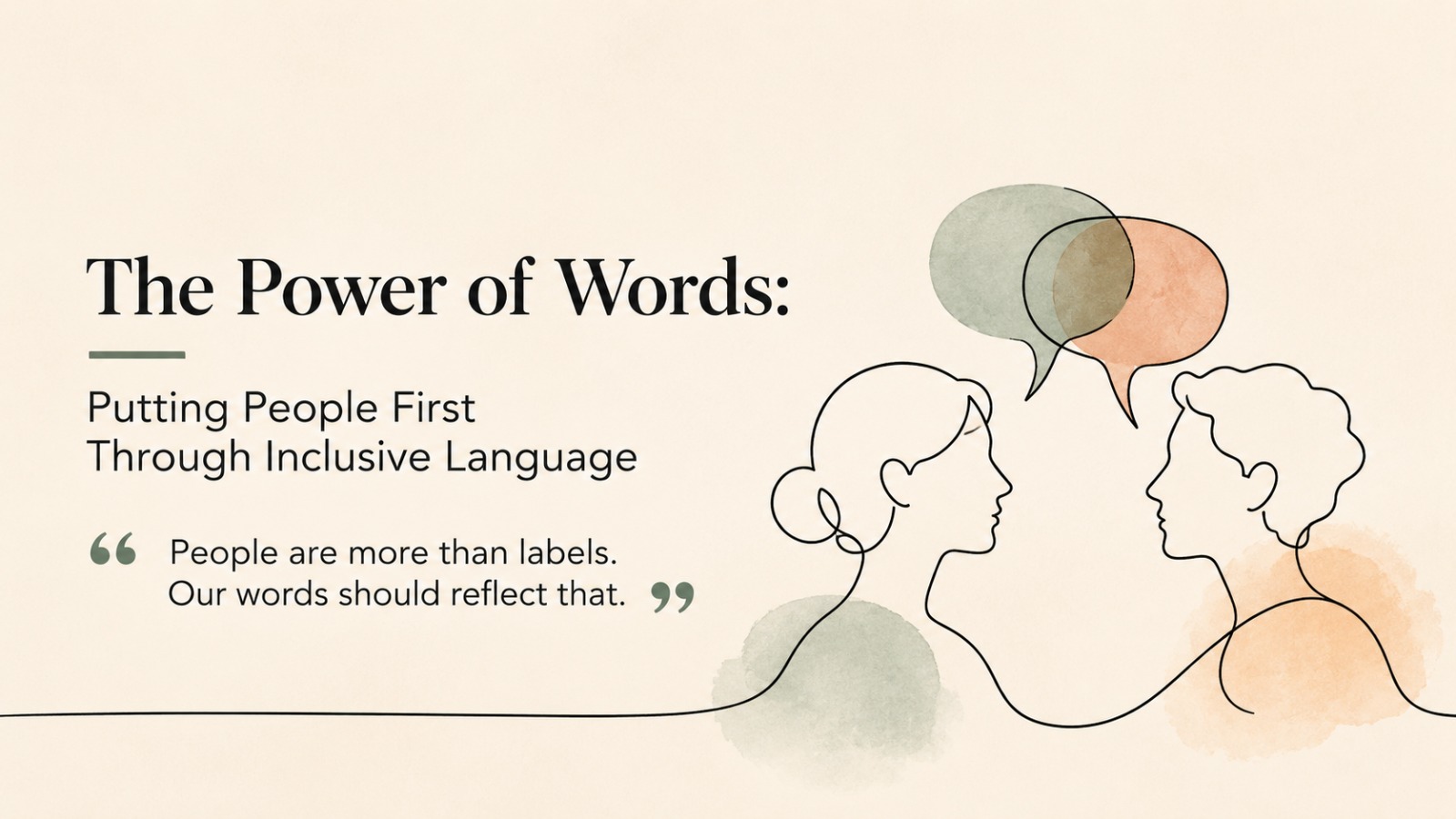
Language
shapes the way we see people, communities, and the world around us. The words
we choose can either open doors or reinforce exclusion. Inclusive
language is about using words that respect diversity, dignity, and human
rights. It avoids stereotypes and recognizes people for who they are, not what
society labels them as.
“The words we use matter because they shape the way we think.” — Lera Boroditsky we use
At its core, inclusive language
acknowledges differences in gender, disability, culture, age, ethnicity, and
lived experience. It ensures that no one feels invisible, reduced, or defined
by a single characteristic. A key part of this approach is people first
language, which places the individual before any condition or identity and
affirms their humanity above all else. When language is inclusive, it creates a
sense of belonging. When it is not, it can deepen inequality even without
intention.
People
first language means recognising the person before the disability or condition.
Saying a person with a disability rather than a disabled person may seem like a
small shift, but it carries deep meaning. It reminds us that disability is only
one aspect of a person’s life and does not define their worth, potential, or
identity.
People-First
Language in Practice
People-first language means
recognising the person before the disability or condition. For example:
- Preferred: “A person with a disability” Avoid:
“A disabled person,” “the disabled,” “handicapped person,” or “crippled
person”
This small shift carries deep meaning. It reminds us
that disability is only one aspect of a person’s life and does not define their
worth, potential, or identity.
Here are common examples of respectful alternatives
(people-first where appropriate):
|
Avoid
(Outdated/Harmful) |
Preferred
(Inclusive/People-First) |
|
Retard,
mentally retarded, mentally challenged |
Person
with an intellectual disability |
|
Handicapped,
crippled, lame |
Person
with a physical disability; person with a mobility impairment |
|
The blind |
Person who
is blind; person with low vision |
|
Wheelchair-bound,
confined to a wheelchair |
Person who
uses a wheelchair; wheelchair user |
|
Suffers
from, victim of, afflicted by |
Person
with [specific condition, e.g., epilepsy] |
|
Special
needs, differently abled |
Person
with a disability |
|
Mongoloid,
Down’s kid |
Person
with Down syndrome |
|
Deaf and
dumb, mute |
Person who
is deaf; person who is hard of hearing |
It is always important to ask the person themselves
what language they prefer, as
individual and community preferences can vary. Some may favour people-first
language, while others prefer identity-first language (e.g., “disabled person”
or “autistic person”). Respecting their choice is the best way to show dignity
and inclusion.
For
many years, language around disability has been shaped by outdated thinking and
social prejudice. Terms such as retard or mentally challenged were once used
casually in everyday speech, institutions, and even official communication.
Today, these terms are widely understood to be harmful, disrespectful, and
unacceptable. They reduce individuals to labels and reinforce stigma and
exclusion.
In
India, the importance of respectful and people centred language is reinforced
by the Rights of Persons with Disabilities Act, 2016. The RPWD Act marks a
shift from a charity based approach to a rights based framework, recognising
persons with disabilities as equal citizens entitled to dignity, autonomy, and
non discrimination. The way individuals are spoken about directly influences
how their rights are understood and upheld. Derogatory or outdated language
goes against the spirit of this law.
Global
organisations such as UNESCO and UNICEF have also consistently emphasised the
need for respectful and non stigmatising language in all communication. Their
guidance highlights that language should never label or dehumanise, but instead
affirm dignity and recognise people as individuals with voices, experiences,
and agency.
Letting
go of harmful terms is part of social progress. Inclusive language is not about
being perfect or fearing mistakes. It is about awareness, intention, and the
willingness to change. When we correct our words, we also begin to correct our
attitudes.
Using
people first language is a shared responsibility. Families, professionals,
institutions, media, and policymakers all play a role in shaping public
understanding. By choosing words that put people first, we take a meaningful
step towards a society rooted in dignity, equality, and respect for all.